

SEO CASE: Thriving in the Storm - 6 Week Strategy. GEO: Sweden

- Niche: iGaming
- GEO: Sweden
- Website Type: One cluster of sites (Single Main Page)
TL;DR - The recent Google updates wiped out thousands of sites. While competitors panicked, we used the volatility as a ladder. We took a client's dead portfolio, moved it to fresh drops, pumped aggressive link volumes, and built a rotation system. Six weeks, ~$33K invested, and a Top-1 hold in Sweden through the middle of one of the roughest update cycles we've seen. Here is exactly how we survived the storm and held the top in Sweden.
The Market Context
Right now, the SERPs are a bloodbath. After the recent updates, sites are dropping, struggling to recover, or failing to index entirely. But for teams with resources, this kind of volatility is a massive opportunity - while competitors give up or wait for the algorithm to settle, you can test, rank, and get deposits.
The client came to us with several active iGaming projects that had completely lost their rankings after the updates. Here is the strategy we executed to bring the money back and generate a good ROI.
How It Was Implemented
1. Setup & The Drop Domains
We didn't rely on the old domains. We needed fresh authority.
We bought 15+ drop domains (Budget: ~$5,000). The client already had about 20 domains ready, but we bought more knowing that redirects have a failure rate and we would need backups.
How we selected the domains:
Topics for the domains varied, but the core selection metrics were past traffic and previously ranked keywords.
We manually checked main metrics and backlink profiles. If a domain had a sudden spike in referring domains with no organic traffic correlation, or if it had previously been used for spam or bad networks, we discarded it. We only bought domains where traffic was lost naturally - the site was simply abandoned or moved to another domain.
Technical implementation:
- No archive content: we didn't restore old content from web archives. We completely rewrote the homepages using AI.
- Static tech stack: the sites were built using simple static HTML - no heavy CMS, no complex plugins. The client used a custom admin panel allowing instant scalability across the network.
- Speed & structure: PageSpeed was at 100. All 404 pages with incoming links were 301-redirected directly to the new main page to preserve link juice.
2. Hiding from Competitors (Cloaking)
In highly competitive niches, if competitors see your strategy, they will copy it. To protect our network, we implemented a strict cloaking system across all sites using Cloudflare WAF and custom server rules.
Googlebot saw the actual optimized content. Real users and competitor bots (Ahrefs, SEMrush, etc.) saw the cloaked content. This kept our links and domain structure completely hidden from the market.
3. Indexation Strategy
Launching 15 sites is useless if Google doesn't index them quickly. We used a two-step approach:
- Manual submission: we pinged each site via Google Search Console using a separate, isolated Google account for each domain.
- Direct traffic injection: we pumped massive volumes of direct traffic (20,000 users per day) into the sites.
When Google detects a massive, sudden influx of direct hits on a new domain, it forces Googlebot to crawl and re-crawl the pages instantly. This accelerated indexation and ensured Google rapidly discovered the thousands of backlinks we were building.
4. The Launch & Filtering
We launched 5 brand-new sites and redirected 10 of the client's old (dropped) sites to the new drop domains.
The survival rate: out of 15 sites, 8 showed signs of life (3 new, 5 old). They grabbed impressions for mid-frequency (MF) and some high-frequency (HF) keywords, initially landing in the 20-30+ range in the SERPs.

Note on the new sites: they didn't rank immediately. We had to do one or two redirects for each domain. Only on the second or third attempt 3 out of 5 finally stick and show results.
We cut the losers and put 100% of our focus on these 8 winners (3 new, 5 old). No further content work was done. From here, it was all about links and recovery strategies.
Active SEO Promotion
Aggressive Link Building
Each of the 8 active sites received a heavy, sustained link velocity of 1,500 to 2,500 backlinks per week per site.
The link mix & anchor strategy:
- Blog posts: provided volume and inflated the Referring Domains (RD) metric. We used 80% HF and MF anchors, others were naked URLs or site name variations.
- Sitewide links: provided brute-force authority. We pushed our exact-match keywords with these high-power links.
For some websites we only posted blog posts, for others only sitewide links, and for some a combination of both. We often combined both link types with the direct traffic boost to speed up indexation of the links and to recover faster.
End of Week 2
Powered by the massive link volume, two sites broke out of the 20+ range and skyrocketed into the Top 1-3 for HF, MF, and LF keywords. Deposits started rolling in immediately.
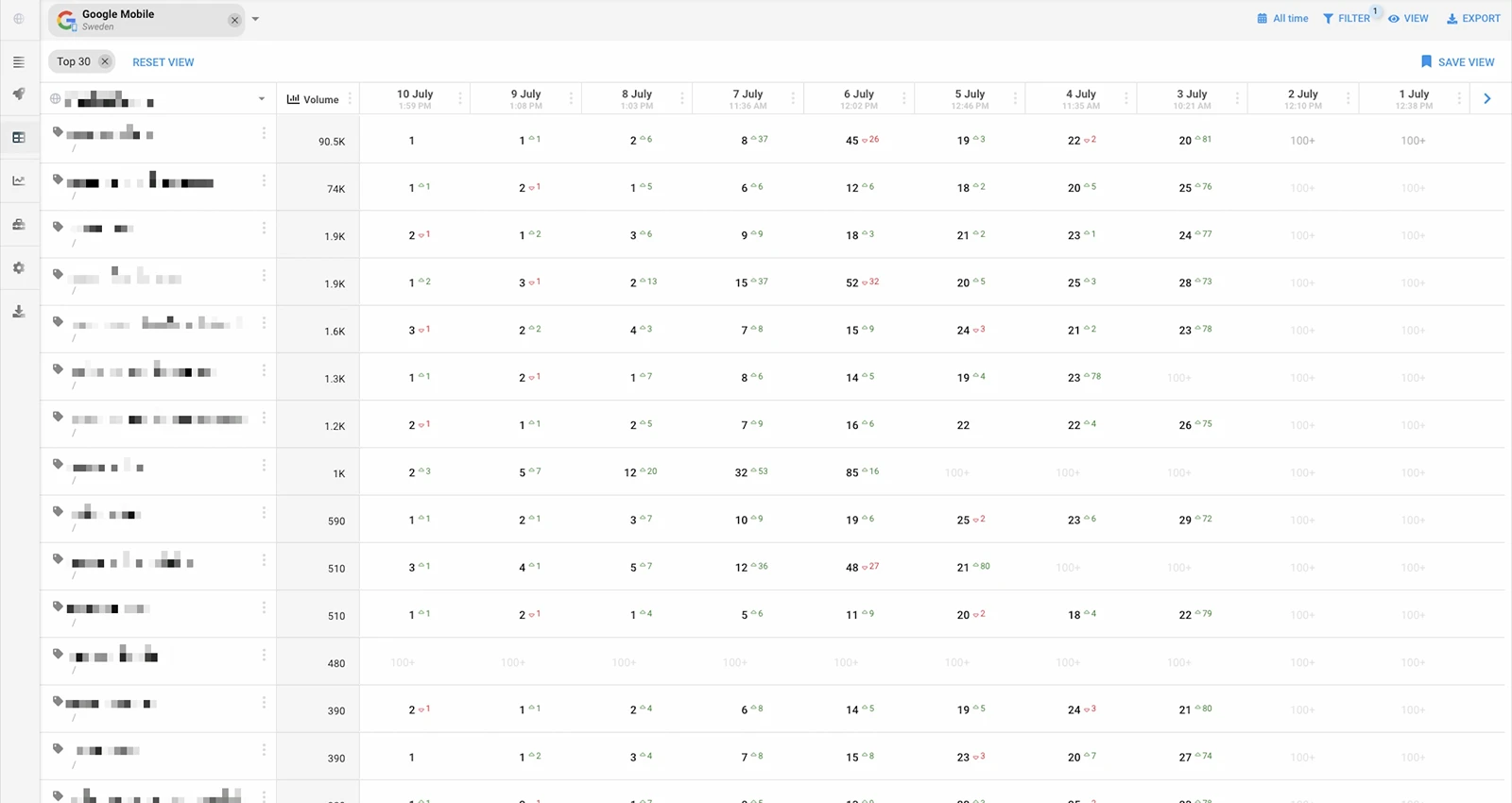
Crucial observation: even when HF keywords danced and fluctuated due to algorithmic updates, the sites held strong for MF and LF keywords, and the deposits didn't stop. We knew about this beforehand, which is why we actively tracked important MF and long-tail keywords - they bring highly converting players while the main keyword is unstable.
The Drop and The Recovery (Weeks 3 to 6)
At the end of Week 3, the Google storm hit us hard. Both of our top-ranking sites were wiped out.
We immediately started testing recovery ideas on the remaining sites in our cluster. The old recovery methods didn't work for our sites: standard 301 redirects and moving sites to subfolders completely failed to recover any positions.
We ran multiple tests across the network - experimenting with exactly where to point the canonicals and testing various hreflang combinations to see what Google likes most. Most combinations failed, but through this aggressive testing, we found two specific setups that consistently bypassed the filters and brought sites back to the top:
- Subdomains: although subfolders didn't work, deploying a full copy of the main site on a subdomain worked perfectly - not a new approach, but it worked with specific canonical/hreflang combinations that we'd found beforehand.
- The EMD hack: linking a drop domain to an Exact Match Domain (EMD) using canonicals and hreflang tags.
Note: subfolders rarely recovered positions during this period, which is why we strictly relied on subdomains and EMDs.
One of the HTML Implementation Code that worked:
<link rel="canonical" href="https://*******.se/">
<link rel="alternate" hreflang="sv" href="https://*******.se/">
<link rel="alternate" hreflang="sv-SE" href="https://sub.*******.se/">
The Rotation Strategy (Weeks 4-6)
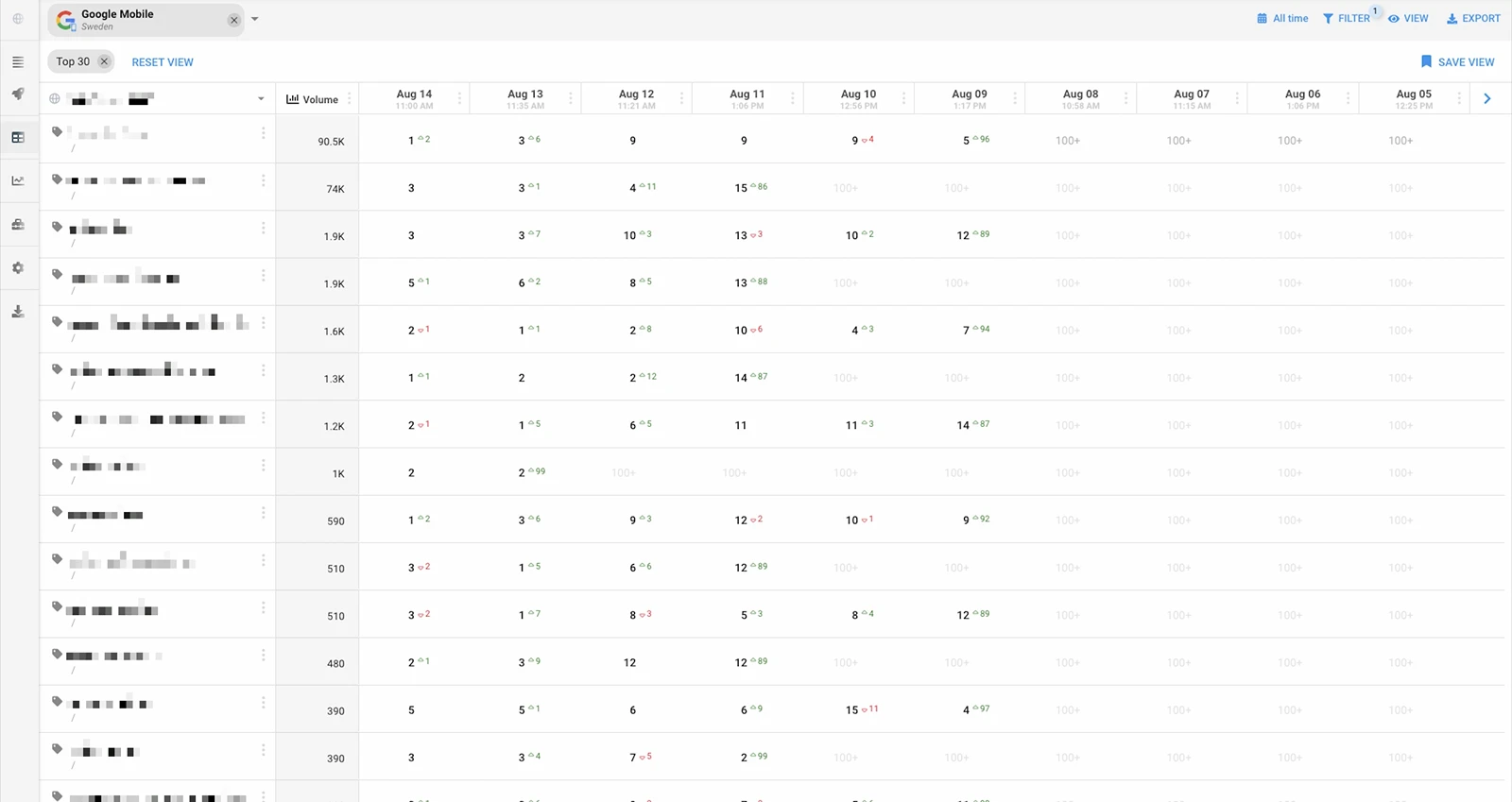
By utilizing these two successful recovery methods, we created a continuous rotation among our 5 main sites. We didn't just push one site and hope for the best - when one site dropped out of the Top, the backup site was already catching the traffic and positions. This allowed us to maintain stable, daily deposits despite the insane SERP volatility.
Ongoing Promotion
Seeing the massive ROI from this campaign, the client decided to scale immediately. While their internal team develops and launches new sites, they've entrusted us to handle the full SEO promotion and link-building strategy to expand their network far beyond Sweden into new GEOs.
However, the reality of modern SEO is that there's no single "magic" strategy that works forever. The algorithms are constantly shifting. That's why we never stop testing on our end - constantly experimenting with new link setups, tag combinations, and recovery mechanics. What worked six months ago has already evolved. To keep our clients at the top, the approach must constantly adapt, and by continuously testing new hypotheses, we make sure they stay ahead of the algorithm.
Financial Overview
Sweden is a Tier-1 GEO. The search volume for our targeted cluster is solid, and the player value (CPA) is exceptionally high compared to other markets.
Because this is a private client project, we are bound by a strict NDA regarding the exact financial metrics. We cannot publicly share the affiliate dashboards, the total number of FTDs, or the final revenue generated over these six weeks.
However, we can transparently share the SEO promotion costs required to execute this strategy:
Investments
- Drop Domains: $5,000;
- Links: ~$25,000;
- Other Expenses: ~$3,000 (traffic, tech, salaries, etc.).
Total Investment: ~$33,000.
Was a $33,000 investment worth it? The answer lies in the client's next move. The profit margin from this six-week rotation was massive enough that the client immediately allocated new budgets to scale this exact framework across multiple new GEOs. In SEO, a client scaling their budget is the ultimate proof of success.
The Takeaways
- Volatility is profitable. If you have the resources to launch, test, and redirect quickly, Google updates actually help you by eliminating slower competitors. While others wait for the storm to pass, you collect their traffic.
- Links are still the ultimate ranking engine. Content updates and rewrites didn't save these sites. Technical optimizations didn't recover them. Massive, continuous link building (1,500-2,500 per week) was one of the core drivers of this success. Even during the wildest algorithm updates, raw link volume and authority dictate Top-1 rankings in highly competitive niches. Stopping your link building during an update is a guaranteed way to lose.
- MF and LF keywords pay the bills. Everyone fights for the main HF keyword, but during an update, HF keywords fluctuate wildly. The sites that ranked well for mid- and low-frequency variations kept generating FTDs even when the main keyword dropped.
- Recovery requires new mechanics. Moving sites to subdomains and using canonicals & hreflangs to pass authority to an EMD - these are some of the recovery tactics that work. But they aren't the only ones - you must constantly test to see what works for your specific cluster today.
- You need a backup rotation. You cannot rely on a single domain in modern SEO. You need a network of sites. When one inevitably falls due to a filter or update, the next one instantly takes its place. The links keep flowing, the traffic shifts to the backup, and the deposits never stop.